
When the Far Right Supports Sex Work: France’s Strange New Alliance

Earlier this month, a startling political move came from the hard-right in France: members of the Rassemblement National (RN) introduced legislation to reopen brothels — but this time as cooperatives run by the sex workers themselves.
That’s a radical proposal for a far-right party. In their framing, it’s about pragmatism: the current criminalization model, which penalizes clients and forces prostitution underground, has made life more dangerous for sex workers, encouraging violence, exploitation, and marginalization. RN lawmaker Jean-Philippe Tanguy said that giving sex workers autonomy and “safe, regulated spaces” could restore dignity and reduce harm.
Suddenly, a cause often championed by social-justice activists, progressive feminists, or libertarian left groups is being advanced by nationalist-right politicians. This story deserves a hard second look, because it flips conventional political alignments, and raises urgent questions about what “rights,” “freedom,” and “protection” mean when they come from unlikely sources.
Why This Shift Makes (Some) Sense Strategically and Politically
Pragmatism over ideology
The RN seems to acknowledge what many policymakers ignore: outlawing or criminalizing sex work rarely eliminates it, instead, it pushes it into the shadows. According to supporters of the new bill, sex workers end up in unsafe environments with little recourse, while clients and pimps operate with impunity.
By legalizing regulated brothels, preferably ones run by the workers themselves, the RN aims to reduce exploitation, increase oversight, and provide a safer environment. It’s an argument grounded in “realism” rather than moral crusade: if sex work happens anyway, better to make it safer and transparent.
Populist appeal and anti-hypocrisy rhetoric
Some RN figures have framed the existing prohibitionist laws as “bourgeois hypocrisy”: pretending to protect morals at the same time that underground sex work thrives, endangering vulnerable individuals.
For a populist party that often criticizes elite hypocrisy, this rhetorical move makes sense. Supporting regulated sex work can be positioned as a kind of “common-sense” protection for working-class people, especially migrants or marginalized women who may disproportionately work in the sex trade.
Co-optation of a social-justice demand for political advantage
By endorsing sex-worker rights, the RN could be reaching for a broader coalition, not just traditional conservative voters, but working-class women, migrants, and people who see regulation and labor rights as more humane than punishment. If successful, this alignment could change how we think about the politics of sex work.
But There Are Serious Cracks and Warnings From History. This isn’t an unqualified victory for sex-worker rights. The alliance is fragile and fraught with contradictions.
Political opportunism, not solidarity
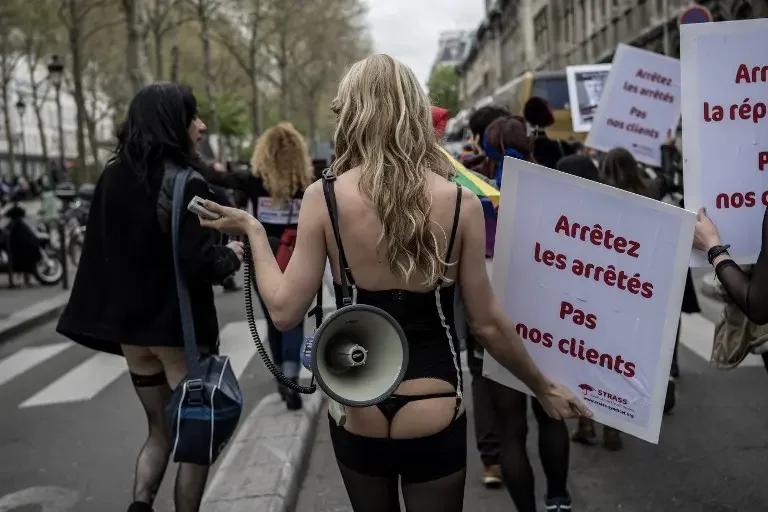
Many sex-worker organizations themselves have publicly rejected the RN’s overture. For example, one spokesperson from a French sex-worker rights group said she “would never ally with the RN” because of the party’s anti-immigration and nationalist agenda. The underlying belief systems, around immigration, nationalism, gender, race, haven’t magically changed. This may be a tactical embrace of regulation, not genuine commitment to sex-worker autonomy. But it poses a problem for sex workers who tend to vote left, who’ve pushed for this type of change for years. What does it mean for liberal sex workers when the party you’ve been told is your enemy suddenly wants to help?
Continued compromise of autonomy and privacy
Even cooperatives or regulated brothels still operate under state oversight, zoning laws, licensing, and (potentially) surveillance. Though safer than criminalized street work, they remain within a system of control, far from the kind of self-determined, stigma-free sex work many advocates envision.
Regulation alone doesn’t guarantee the economic or social empowerment of every sex worker. Some may still face coercion, discrimination, or unsafe working conditions.
Risk of instrumentalization and political backlash
If this alliance becomes mainstream, it could normalize sex work, but it could also weaponize it politically. A far-right party might use regulated sex work as leverage: promoting strict immigration, policing, and moral conservatism while offering a regulated “sex industry” as a compromise. That duality could reinforce social stigmas, exploit vulnerabilities, and maintain structural inequalities under a veneer of “safety.”
Compare this French moment with the typical stance of the American far right: historically rooted in religious conservatism, moral policing, anti-pornography campaigns, and strong opposition to sex work, pornography, and brothels.
Groups like National Center on Sexual Exploitation (NCOSE) have long campaigned against decriminalization of sex work, sex-positive discourse, and legal pornography, viewing them as social harms rather than expressions of agency.
Prostitution remains largely criminalized in most U.S. states (with limited exceptions), and popular opinion often leans toward shrinking, not expanding, the sex industry. A 2020 poll report found that a majority of U.S. voters described prostitution as something their communities should shrink rather than grow, and were skeptical of full decriminalization.
So as of now, a pro-sex-worker, decriminalization-friendly far right is almost unimaginable in the U.S. and the American far right remains largely aligned with moral-conservative prohibitionism, not labor or autonomy-based regulation.
The French far-right’s flirtation with sex-worker rights reveals something important: political alignments are not fixed. Social movements can sometimes make unlikely allies. If regulated sex work is framed as a pragmatic, worker-rights issue, rather than moral or ideological crusade, it can resonate beyond traditional political divides.
Potential gains if this trend holds:
Safer working conditions for sex workers, fewer arrests and less underground exploitation.
More public discussion of sex work as labor, not vice, reducing stigma.
Legal recognition of sex workers’ autonomy and ability to operate safely, with access to health care and rights.
Risks if this is merely political posturing:
Sex work co-opted as a “wedge issue”, a way to expand far-right appeal among struggling or marginalized populations, without real commitment to rights or safety.
Regulation without decriminalization may still render sex work conditional, controlled, and surveilled.
Marginalized workers (migrants, trans people, people of color) may remain vulnerable to exploitation, even under a “legal” system.

Personally, I’m torn. On the one hand, I believe no political alignment should be dismissed out of principle. If a far-right party supports regulation that could materially improve safety for sex workers, that deserves serious consideration, not reactive condemnation.
On the other hand, the history of the far right is heavy with control. There is a very real danger this “alliance” is less about justice and dignity and more about optics, political opportunism, and social control.
For sex-worker rights advocates, this moment presents a dilemma: do you accept potential gains from unlikely allies or risk losing support if the moral foundations remain inconsistent?
If there’s any hope in this strange convergence, it will come only if sex-worker communities maintain autonomy, vigilance, and self-determination, insisting that regulation be worker-led, rights-based, decriminalized, and not another form of institutional control.
